
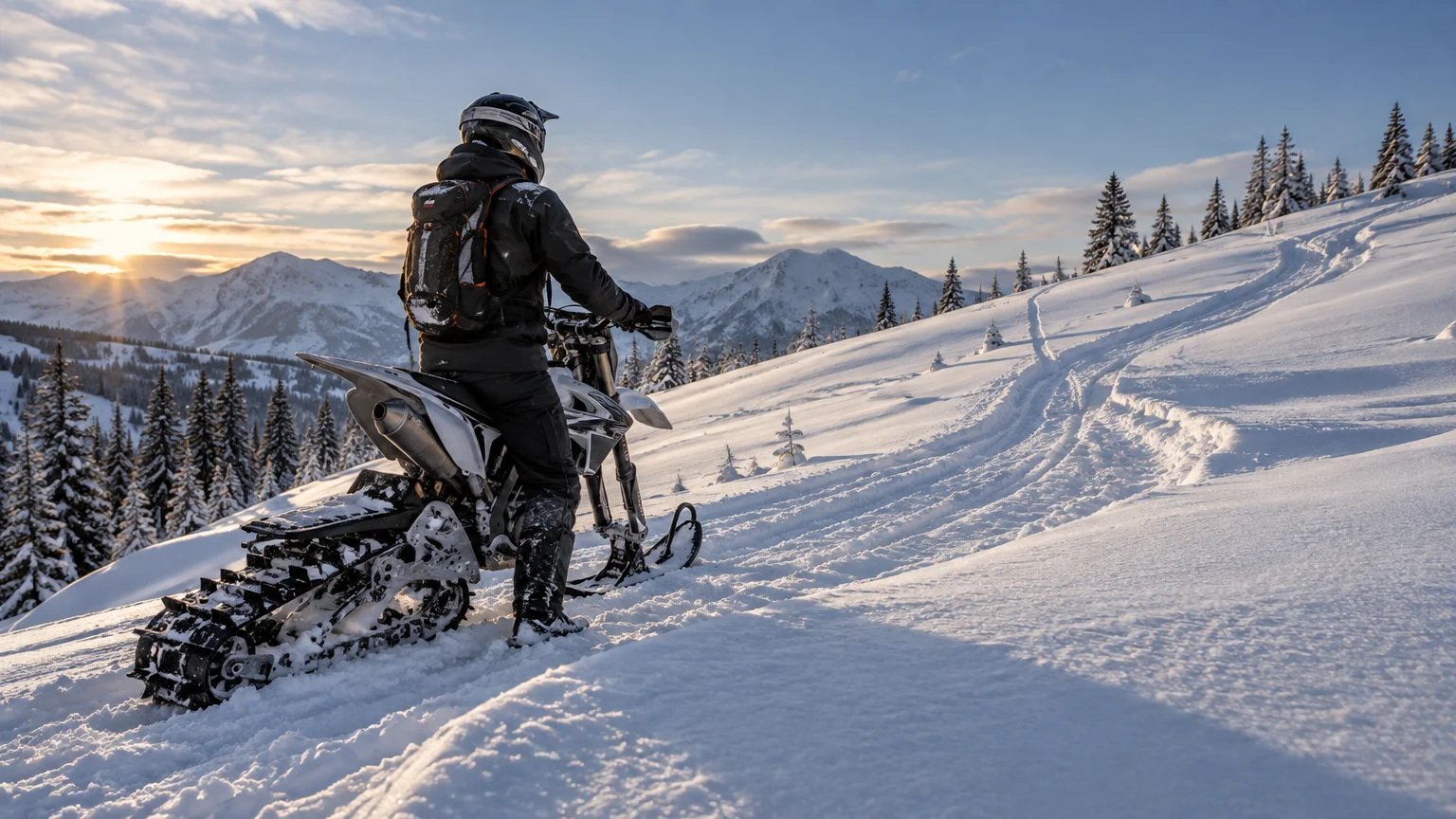
TLDR: The core snow bike line choice snow texture rule is simple: choose the snow that offers predictable support, a visible exit, and enough room to adjust. Do not automatically chase the deepest powder, the smoothest-looking patch, or the most established trench. Read the surface before entering it, set your speed early, and treat prolonged hardpack or thin-cover travel as a machine-wear problem as well as a traction problem.
A snow bike—a dirt bike converted with a front ski and rear track—can cross several different surfaces in one short climb. Fresh powder may become wind-packed slab, tracked snow may end at glazed hardpack, and an innocent white patch may hide slush or a buried rut. Good snow bike line choice snow texture judgment means spotting that transition before the ski reaches it. By then, your braking, body position, and escape route should already be sorted.
Read support, direction, and exit before committing
Start by asking three questions: Will this snow support the ski and track consistently? Where will the surface try to send the bike? Where can I exit if it collapses, hooks the ski, or provides less traction than expected?
The best line is usually the most predictable line, not necessarily the softest one. Deep untouched snow can deliver excellent track bite but require substantial momentum. A packed lane can conserve energy but become polished and slippery. An existing trench may look efficient until its walls capture the ski and dictate the bike’s direction.
When stopped, look for shine, wind ripples, exposed vegetation, dirty snow, standing water, drainage depressions, abrupt color changes, and tracks that sink or punch through. While moving, watch how snow leaves the ski and track. Loose spray suggests a different surface from a glossy strip that produces little displaced snow. Feel for changes in steering effort and track load, but do not wait for a major deflection to decide what the surface is doing.
- Identify the dominant texture: soft, supportive, polished, breakable, wet, thin, or deeply rutted.
- Locate the exit before looking for the fastest entrance.
- Choose a braking zone before the questionable surface, not in its middle.
- Scan beyond the snow for stumps, rocks, creek edges, fences, traffic, and terrain traps.
- Leave enough width to alter the line without a desperate steering input.
Snow bike line choice by snow texture
| Snow texture | Line priority | Rider and machine watch-outs |
|---|---|---|
| Fresh powder | Favor a line with consistent depth, room to maintain an arc, and a firm exit. Avoid blind depressions even when the surface looks untouched. | Carry workable momentum before entering. Excessive speed can eliminate your ability to change course when the snow is deeper than expected. |
| Tracked or chopped snow | Look for a broad, supportive lane or cross old tracks at a deliberate angle. Avoid narrow channels that capture the ski. | Stand, stay mobile, and let the bike move beneath you. Expect alternating support as the ski crosses trenches and piles. |
| Firm packed snow | Use predictable, lightly textured snow where possible. Finish major braking before polished corners or descents. | Steering and braking margins shrink as the surface becomes harder and slicker. Use smooth control inputs. |
| Glazed hardpack or ice | Choose the shortest practical exposure, the lowest-consequence path, and an exit that does not require a sharp turn. | Avoid abrupt direction changes. Hard surfaces can also reduce snow lubrication reaching the rail slides. |
| Breakable crust | Prefer uniformly supportive crust or uniformly soft snow rather than a patchwork of both. Keep an open escape lane. | The ski or track can punch through at different moments, producing sudden drag or steering deflection. |
| Wet snow or slush | Avoid low drainage areas and suspiciously flat basins when a higher, supported route exists. | Wet snow can add drag quickly. Hidden slush may sit beneath a thin layer of fresh powder. |
| Thin-cover connector | Use available loose snow and minimize distance on exposed or polished surfaces. Turn around if the route cannot protect the machine or rider. | Insufficient snow can accelerate wear to the ski, skags, rail slides, track, and related components on systems that depend on snow lubrication. |
Match your inputs to the surface transition
Momentum is useful in soft snow, but it is not a substitute for line planning. Build a steady pace while traction is available, then use smooth throttle through the soft section. A last-second burst can unload the front, widen the line, or carry the bike into terrain you have not inspected. The goal is enough drive to keep the track working—not maximum speed.
Reverse that thinking before slick snow. Complete most braking while the bike is upright and the surface still offers bite. Enter hardpack with a speed that lets you use small steering and throttle inputs. The 2023 Timbersled owner’s manual warns that hardpack and ice reduce steering and braking control and advises against abrupt direction changes on slippery surfaces.
Stay standing and mobile through chopped snow, crust, and ruts when terrain and your skill permit. Look toward the intended exit rather than down at the ski. Keep your upper body ready to absorb a deflection without making a violent correction. If an old trench must be crossed, approach it deliberately instead of drifting into it nearly parallel, where the ski is more likely to follow the rut.
Slow down when the consequences of losing support rise. That includes sidehills above trees, creek crossings, tight routes between buried obstacles, blind rollovers, and any patch where braking space disappears. Texture may tell you how the machine will behave, but terrain determines what a mistake will cost.
Powder is not automatically the best line
Untouched powder is attractive because it can provide loose snow for the track and freedom from established ruts. It can also conceal holes, logs, rocks, drainage channels, and abrupt changes in depth. The deepest-looking line is a poor choice when it has no visible exit or demands more momentum than the available stopping distance allows.
On a mixed trail, the best route may shift between the loose edge and the packed center. Use the loose edge when it provides consistent support and useful snow contact without putting the ski near branches, ditches, or hidden rocks. Use the packed center when it remains textured and controllable. Avoid treating either as a permanent rule; scan several bike lengths ahead and move before the texture changes.
Crust and slush deserve extra suspicion
Breakable crust creates a nasty mismatch: the surface appears firm until the ski, track, or both punch through. If one end breaks through first, the bike can yaw or slow abruptly. Favor snow with uniform support, keep your knees and elbows active, and leave room to ride out the deflection rather than fighting for an exact tire-width line.
Slush is deceptive for a different reason. It can be hidden beneath a thin layer of fresh snow, particularly around low areas and water. The New York State Parks snowmobile safety material describes crust formation following temperature swings or freezing rain and warns that fresh powder can conceal slush. Although that document addresses snowmobiles, those surface-identification hazards remain relevant when selecting a route for a tracked snow bike.
If a low patch looks suspicious, inspect it from stable ground rather than charging in to test it. Consider drainage, recent warming, rain, and whether earlier tracks show dark or saturated snow. A route around the depression is usually cheaper than extracting a stuck bike while its track and suspension pack with wet snow.
Hardpack can become a durability problem
Hard snow is not merely a less entertaining version of powder. On Timbersled systems, manufacturer guidance says inadequate snow can cause excessive wear or damage involving the rail slides, track, ski, skags, and spindle. The company advises avoiding extended operation on ice, hardpack, and roads because insufficient snow lubrication can overheat rail slides and damage the track.
That does not establish one universal limit for every conversion kit. Designs, rail-slide materials, paddle heights, scratcher arrangements, and manufacturer procedures vary. It does establish a useful decision rule: if your route forces prolonged travel over polished or low-snow ground, do not frame it only as a traction challenge. Shorten the exposure, find loose snow where safe, change the route, or turn around according to the guidance for your exact system.
Timbersled recommends compatible ice scratchers for applicable systems used frequently on hardpack, noting that tall-paddle mountain configurations may leave rails and sliders above the snow on groomed trails. Scratchers are not a universal permission slip for road or ice travel. Confirm kit compatibility, deployment instructions, reverse-use restrictions, and inspection requirements in the exact manufacturer documentation.
Check the machine when handling feels wrong
Not every vague front end or wandering track is caused by snow texture. Track condition, setup, worn steering-contact parts, and suspension balance can change how clearly the bike communicates with the rider. If handling changes persist across several known surfaces, stop blaming the snow and inspect the machine.
- Check track alignment and tension using the procedure and specification for the exact kit. Timbersled identifies both as critical to handling and warns that an overly loose or overly tight track can cause damage.
- Inspect rail slides for abnormal wear or signs of heat, particularly after hardpack or low-snow travel.
- Inspect the ski, skags, spindle area, track, and visible suspension components for damage or unusual wear.
- Clear packed snow and ice where the manufacturer permits, with the engine shut down and the machine secured according to its manual.
- Confirm that any scratchers are compatible, intact, and being used as instructed.
- Record setup changes rather than stacking several adjustments at once.
Suspension preload can affect ski-to-ground pressure and overall vehicle balance on the documented Timbersled systems. The owner’s manual recommends making small changes and conducting a test ride after each adjustment. Do not copy another rider’s preload settings without accounting for the exact bike, kit, rider weight, cargo, and snow conditions. If you are still choosing a conversion platform, start with the fitment and ownership checks that matter before converting a dirt bike into a snow bike.
Know when texture stops being the main decision
A clean-looking powder line can still cross avalanche terrain. Snow texture at the ski does not tell you whether the slope above is stable. Current local avalanche and weather forecasts, recent avalanche activity, cracks, whumpfing, heavy snowfall, wind loading, rain, and rapid warming all belong in the larger terrain decision.
That boundary matters: riding technique cannot rescue a poor terrain choice. If the line enters or sits beneath avalanche terrain, use appropriate training, local forecasts, rescue equipment, group protocols, and conservative route selection. For a broader winter risk check before leaving the trailer, review the safety and risks of riding a dirt bike in snow. Visibility, traffic, thin ice, buried obstacles, and remoteness can also override an otherwise favorable texture reading.
The practical takeaway
Read the snow early enough to act before traction changes. Choose predictable support over visual perfection, preserve a visible exit, carry controlled momentum into soft snow, and finish major braking before slick snow. Stay loose through ruts and crust, but do not confuse aggressive inputs with control.
Most importantly, recognize when the surface is asking too much from the machine. Extended polished hardpack, ice, roads, and thin cover can reduce control and snow lubrication. A smart line protects the ski and track system while leaving the rider somewhere safe to go. If the route offers neither, the right line is the turn back to better snow.
References
- 2023 Timbersled SX 120 / ARO / RIOT Owner’s Manual – Polaris Online Publication Portal
- Snowmobile Safety Education Instructor's Manual
- Snow Bike System Break-In and Maintenance | Timbersled Snow Bike Systems Canada
- Snowmobile and Snow Bike Mountain Riding Safety | Timbersled Snow Bike Systems
- Timbersled Track Maintenance | Timbersled Snow Bike Systems