
TLDR
The right sticker type depends on where it will be applied, how long it needs to last, how the artwork should look, and how the stickers will be distributed.
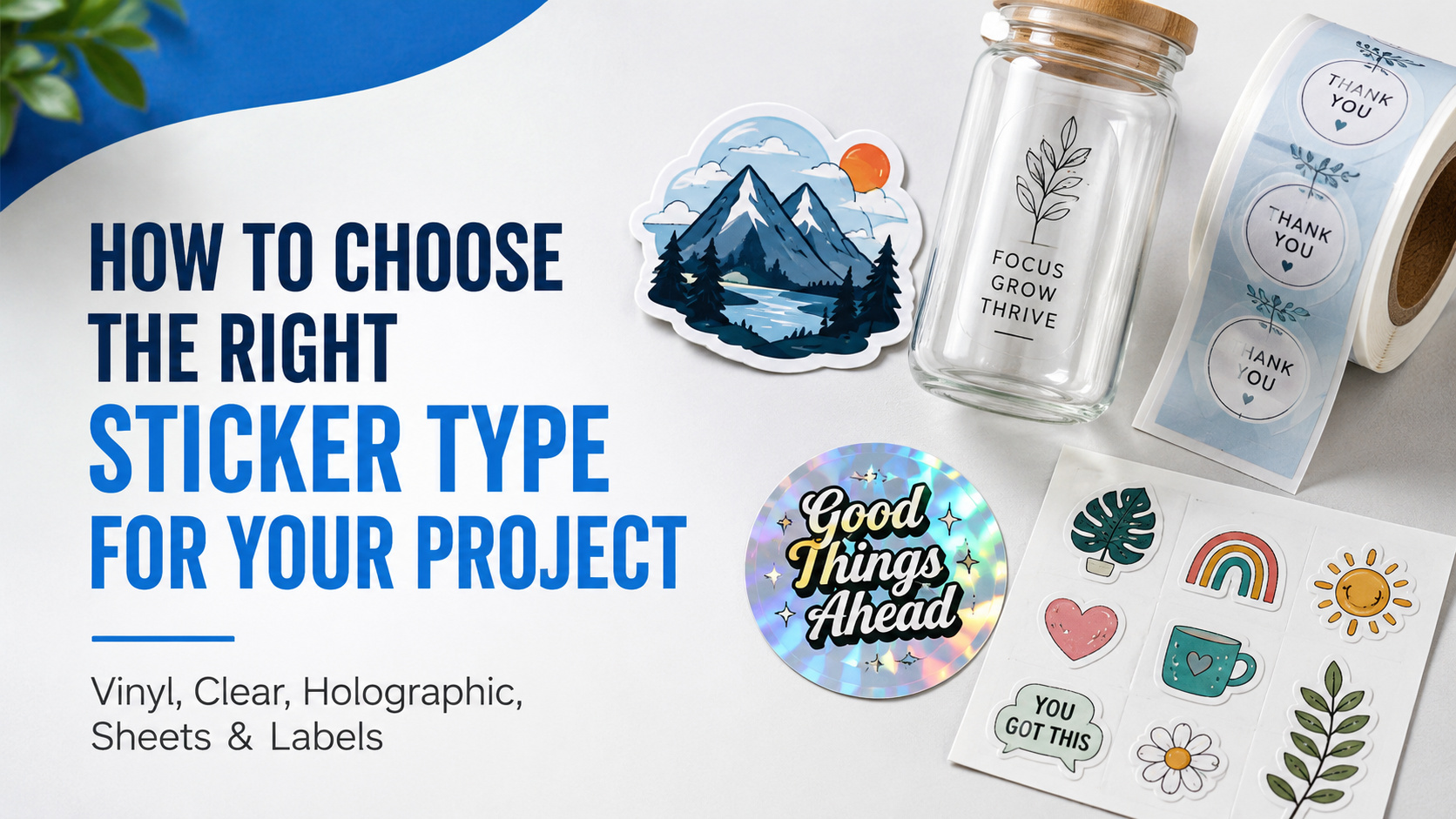
For most general projects, laminated white vinyl is the safest choice. Use clear stickers when the surface should show through, holographic or chrome stickers for special visual effects, kiss cut stickers for easier peeling, sticker sheets for multiple designs, and roll labels for product packaging.
Before ordering, answer four questions:
- Where will the sticker go?
- Will it face water, sunlight, heat, or frequent handling?
- Should it be handed out individually or applied in volume?
- Does the design need a solid white background, transparent areas, or a metallic effect?
Choosing a sticker seems simple until the options start piling up.
Should it be vinyl or clear? Die cut or kiss cut? Matte or glossy? Should you order individual stickers, sheets, or rolls? And does the project need permanent adhesive, removable adhesive, or something designed specifically for vehicles?
Learning how to choose the right sticker type for your project becomes easier once you stop comparing every option at once. Start with the intended use. The surface, environment, artwork, and application process will usually narrow the choices quickly.
Start With the Sticker’s Job
The first question is not what material you like. It is what the sticker needs to do.
A sticker meant to decorate a laptop has a different job than a label placed on 2,000 cosmetic bottles. A temporary parking decal has different requirements than a permanent safety label. A limited-edition artist sticker may benefit from an unusual finish, while a small QR code needs predictable contrast and readability.
Define the main job before choosing the product.
Common sticker projects include:
- Brand giveaways
- Product packaging
- Water bottle decals
- Laptop stickers
- Vehicle graphics
- Window displays
- Event handouts
- Artist merchandise
- Equipment identification
- Shipping-box seals
- Planner and organization stickers
- Temporary promotions
YouStickers separates individual stickers from packaging-focused labels. Its standard stickers are intended for merchandise, giveaways, events, laptops, bottles, and general branding. Its roll labels are designed for bottles, jars, boxes, retail products, and repeated application.
That distinction gives you a useful starting rule:
Choose individual stickers when the sticker itself is the item. Choose labels when the sticker is part of the packaging process.
Quick Sticker Type Comparison
| Project | Recommended Sticker Type | Main Reason |
|---|---|---|
| General logos and artwork | White vinyl sticker | Strong color and broad surface compatibility |
| Laptop or water bottle | Laminated vinyl | Better resistance to water, scratches, and handling |
| Glass jar or window | Clear sticker | Surface remains visible around the design |
| Artist merch or special release | Holographic or chrome | Reflective finish adds visual interest |
| Intricate individual design | Kiss cut sticker | Backing protects narrow edges and makes peeling easier |
| Several small designs | Sticker sheet | Multiple stickers stay organized on one sheet |
| Product packaging | Roll label | Faster application and easier handling in volume |
| Vehicle message | Bumper sticker | Outdoor material and vehicle-conscious adhesive |
| Temporary promotion | Removable sticker | Easier removal when the campaign ends |
| Permanent branding | Permanent vinyl | Stronger long-term bond |
This table is a starting point, not an absolute rule. Surface texture, artwork, temperature, and customer expectations can change the best choice.
Choose White Vinyl for the Safest All-Purpose Option
For most general projects, white vinyl is the best place to start.
The opaque white material provides a consistent base behind the artwork. Colors do not depend heavily on the object underneath, white elements remain white, and small text is usually easier to read.
This makes white vinyl useful for:
- Business logos
- Artist stickers
- Laptop decals
- Water bottles
- Toolboxes
- Event giveaways
- Packaging inserts
- Helmets
- Retail handouts
- General outdoor branding
YouStickers prints its laminated vinyl stickers on outdoor vinyl and offers matte or gloss laminate. The laminate helps protect the printed surface from water, sunlight, scratching, and everyday handling.
White vinyl is especially useful when you do not know where recipients will apply the stickers. A giveaway may end up on a black laptop, a blue water bottle, a cardboard box, or a silver toolbox. The opaque backing keeps the artwork more predictable across those surfaces.
Choose white vinyl when:
- Color accuracy matters.
- The artwork includes white.
- The sticker contains small text.
- The receiving surface may be dark or colorful.
- You need one material that works for many uses.
- The design should look the same wherever it is applied.
Choose Clear Stickers for a Printed-On Appearance
Clear stickers are printed on transparent material, allowing the surface underneath to remain visible.
They are often used on:
- Glass bottles
- Jars
- Windows
- Mirrors
- Clear product packaging
- Acrylic displays
- Smooth plastic
- Minimalist containers
A clear sticker can create a subtle, “printed-on” look because there is no opaque white field around the artwork. YouStickers offers clear sticker printing with optional white ink under selected parts of the design. The white underprint helps colors remain more visible on transparent material.
Clear stickers require more planning than white vinyl.
The background color affects the final appearance. Black lettering may look sharp on clear glass but disappear on a dark bottle. Pale artwork can become hard to see without white ink. Transparent sections may also reveal seams, liquid, shadows, or other visual distractions behind the sticker.
Use clear stickers when the surface is meant to be part of the design.
Avoid them when:
- The background will change between applications.
- The surface is dark or visually busy.
- Small text must remain highly readable.
- Exact color consistency is important.
- The artwork relies heavily on white.
For most first-time sticker orders, white vinyl is more forgiving. Clear stickers are better when the transparent effect serves a specific purpose.
Choose Holographic Stickers for Shifting Rainbow Effects
Holographic stickers use a reflective material that changes appearance as the viewing angle and light change.
They work well for:
- Artist merchandise
- Limited releases
- Event collectibles
- Fantasy artwork
- Gaming designs
- Cosmetics
- Special packaging seals
- Promotional drops
- Designs with stars, chrome, lightning, or metallic details
The best holographic designs do not simply print solid ink over the entire material. They leave selected areas open so the reflective rainbow effect can show through.
YouStickers’ holographic vinyl stickers can use white ink beneath parts of the artwork. Areas with white ink appear more solid and color-accurate, while areas without it retain more of the holographic effect.
Holographic material works best with:
- Bold outlines
- Clear shapes
- Strong contrast
- Intentional reflective areas
- Limited fine text
It is less suitable when the design needs restrained color, a natural paper appearance, or exact reproduction of subtle photography.
Use it because the reflective finish supports the artwork, not simply because it attracts attention.
Choose Chrome Stickers for a Mirror-Metallic Look
Chrome stickers use reflective silver material rather than a rainbow holographic pattern.
They are useful for:
- Automotive-inspired designs
- Equipment branding
- Tech logos
- Sci-fi artwork
- Metal-style lettering
- Product seals
- Sports graphics
- Limited-edition merchandise
YouStickers describes its custom chrome stickers as a metalized film with a mirror finish. White ink can be placed beneath selected parts to keep them opaque, while other areas remain reflective.
Chrome creates a stronger metallic effect than standard silver-colored printing. But it can also create glare, and fine details may be harder to see when every area is reflective.
Use chrome selectively. A reflective border, wordmark, icon, or background area often works better than turning the full design into a mirror.
Choose Die Cut Stickers for a Finished Custom Shape
Die cut stickers are cut through both the sticker material and backing paper around the outer shape of the design.
If the artwork is a cat, the finished sticker can follow the cat’s outline. If it is a logo, the sticker can follow the logo instead of arriving as a plain square.
Die cut stickers work well for:
- Logo giveaways
- Art stickers
- Merchandise
- Brand mascots
- Individual promotional stickers
- Packaging inserts
- Convention handouts
The custom outer shape helps the sticker feel like a finished object. It also puts the focus on the artwork rather than the backing.
Die cut is usually the best choice when customers will see, handle, sell, or photograph the stickers before applying them.
But very narrow points, tiny gaps, and delicate extensions may bend more easily because the backing follows the same shape as the sticker. That is where kiss cut stickers can be helpful.
Choose Kiss Cut Stickers for Easier Peeling
A kiss cut sticker is cut through the sticker layer while leaving the larger backing sheet intact.
The customer still receives one sticker, but the backing may be square, rectangular, or another simple shape around it.
This format is useful for:
- Intricate designs
- Narrow lettering
- Delicate shapes
- Event handouts
- Mailing inserts
- Stickers that need an easy-peel edge
- Designs that need extra printed information around them
YouStickers’ kiss cut stickers use an intact backing that protects the sticker’s smaller details and creates additional space around the design. The surrounding area can also make the sticker easier to peel.
Choose kiss cut when function matters more than the shape of the loose sticker.
Choose die cut when the finished presentation of the individual sticker matters most.
Choose Sticker Sheets for Multiple Designs
Sticker sheets place several kiss-cut stickers on one shared backing page.
They are one of the best formats for:
- Planner stickers
- Children’s activity sheets
- Artist collections
- Small logo sets
- Product icons
- Classroom rewards
- Event freebies
- Subscription boxes
- Themed sticker packs
- Multiple small labels
A sheet can include different sizes and shapes. It can also include branding, instructions, a title, or decorative artwork on the backing.
Custom sticker sheets from YouStickers allow multiple peelable designs to be arranged on one page. The format is intended for themed sets, small artwork, mailers, creator merchandise, and designs that are easier to store together than as loose pieces.
Sheets are often more practical than ordering many tiny individual stickers. They keep the designs organized and give customers a complete collection in one item.
Choose Roll Labels for Packaging and High-Volume Application
Roll labels are usually the better choice when stickers must be applied repeatedly to products or packaging.
Common uses include:
- Bottles
- Jars
- Cosmetic containers
- Coffee bags
- Shipping boxes
- Food packaging
- Candle jars
- Product pouches
- Retail containers
- Tissue-paper seals
Loose individual stickers may work for a few packages. Once employees are labeling hundreds or thousands of items, rolls become easier to store, peel, and apply.
YouStickers prints its roll stickers and product labels on BOPP film and winds them on a standard core for hand application, dispensers, or label applicators. The material is intended to resist moisture, oils, scuffs, and normal packaging exposure.
Choose rolls when:
- The same design will be applied repeatedly.
- Application speed matters.
- Labels need to stay organized.
- The products are being packaged at scale.
- The labels may be used with a dispenser or machine.
Choose individual vinyl stickers when the sticker will be sold, handed out, or included as a separate promotional item.
Choose Bumper Stickers for Vehicle Messages
A standard vinyl sticker can work on many smooth vehicle surfaces, but a dedicated bumper sticker is usually better for long horizontal messages and customer-friendly removal.
Bumper stickers are useful for:
- Campaign messages
- Business names
- Club branding
- School organizations
- Causes
- Event promotion
- Short slogans
- Vehicle identification
YouStickers’ custom bumper stickers are made from laminated outdoor vinyl and use an adhesive intended to hold during road exposure while allowing more practical removal later.
Keep vehicle designs simple. Drivers and pedestrians may only see the message for a few seconds.
Use:
- Large text
- High contrast
- A short message
- A clear logo
- Minimal contact information
A long paragraph, detailed illustration, and small QR code will be difficult to understand from another vehicle.
Decide Between Matte and Gloss
Finish changes both the appearance and usability of the sticker.
Matte Finish
Matte laminate has lower glare and a softer surface.
It works well for:
- Fine art
- Black-and-white designs
- Natural products
- Vintage artwork
- Minimal branding
- Stickers with small text
- Products photographed under bright lighting
Matte can make the design feel understated and can improve readability under direct light.
Gloss Finish
Gloss laminate has a shinier appearance and stronger reflections.
It works well for:
- Bright illustrations
- Bold logos
- Children’s stickers
- Sports graphics
- Colorful merchandise
- Food and beverage branding
- Designs intended to look polished
YouStickers offers both matte and gloss laminate on its standard vinyl stickers. Matte creates a lower-glare appearance, while gloss adds more shine and visual contrast.
Neither finish is universally better. Match the finish to the design and viewing conditions.
Choose the Adhesive Based on the Removal Plan
The strongest adhesive is not always the right adhesive.
Use permanent adhesive when the sticker should remain attached for long-term branding, identification, decoration, or packaging.
Typical permanent uses include:
- Product labels
- Water bottles
- Laptops
- Equipment
- Outdoor decals
- Retail packaging
- Brand stickers
Use removable adhesive when the sticker is temporary or the customer is expected to remove it later.
Typical removable uses include:
- Bumper stickers
- Seasonal campaigns
- Temporary window promotions
- Event signage
- Parking passes
- Reusable containers
YouStickers notes that its standard custom stickers, transfer graphics, lettering, and labels use permanent adhesive, while its bumper stickers use removable adhesive.
Remember that removable does not mean reusable. It also does not guarantee residue-free removal from every surface. Heat, sunlight, age, paint condition, and surface chemistry can all affect the result.
Check the Surface Before Ordering
Even the correct sticker material can fail on the wrong surface.
Stickers generally perform best on surfaces that are:
- Smooth
- Clean
- Dry
- Nonporous
- Free from oil and wax
- Fully cured
- Firm enough to support adhesive contact
Adhesion can be less predictable on:
- Textured walls
- Silicone
- Rubber
- Oily plastic
- Fabric
- Unsealed wood
- Rough concrete
- Powder-coated surfaces
- Low-energy plastics
- Recently painted surfaces
3M’s graphic-film guidance states that surfaces should be treated as contaminated and cleaned before application. It also recommends checking the substrate type, condition, paint cure, surface texture, and material compatibility before installing graphics.
For an important or unusual project, test a sample on the actual surface.
Do not test only on a clean glass panel and assume the sticker will behave the same on a textured bottle, coated box, painted wall, or plastic storage bin.
Match the Artwork to the Sticker Material
Some artwork works better on certain materials.
Choose White Vinyl For:
- Full-color illustrations
- Photographs
- Small text
- QR codes
- Detailed logos
- Designs containing white
Choose Clear Vinyl For:
- Minimal logos
- Window graphics
- Transparent product packaging
- Designs where the surface should remain visible
Choose Holographic or Chrome For:
- Bold line art
- Metallic effects
- Special editions
- Reflective accents
- Designs with planned white-ink areas
Choose Kiss Cut For:
- Fine points
- Intricate outlines
- Narrow lettering
- Stickers that need easier peeling
Choose Sheets For:
- Several related designs
- Small icons
- Themed collections
- Planner sets
- Labels in several sizes
The sticker material should support the artwork. It should not force a visual effect that makes the design harder to understand.
A Simple Sticker Decision Process
Use this sequence before placing an order.
1. Identify the Surface
Is it glass, plastic, metal, cardboard, a vehicle, or something else?
2. Decide How Long It Should Stay
Is the sticker temporary, seasonal, or intended to remain for years?
3. Consider the Environment
Will it face sunlight, water, refrigeration, heat, oils, abrasion, or frequent handling?
4. Choose the Presentation Format
Will the stickers be loose, sold individually, placed on a sheet, or applied from a roll?
5. Match the Material to the Artwork
Does the design need an opaque white base, transparent areas, rainbow effects, or metallic shine?
6. Choose Matte or Gloss
Consider glare, color, photography, and the overall brand style.
7. Review a Proof
Check the cutline, size, border, spelling, small text, and transparent or reflective areas.
YouStickers provides a free online proof before production, allowing customers to review the shape, artwork setup, and overall appearance before printing.
Final Thoughts
Choosing the right sticker type starts with the project, not the finish.
Use laminated white vinyl when you need a dependable general-purpose sticker. Choose clear material when the surface should show through. Use holographic or chrome for artwork that benefits from reflective effects. Choose kiss cut for easier peeling, sheets for multiple designs, rolls for packaging, and bumper stickers for temporary vehicle messages.
Then check the details that determine whether the sticker actually works: surface texture, exposure, adhesive, artwork, size, and application method.
You can compare custom sticker options and choose the material, cut style, finish, and format that best fits the project. Review the proof carefully, test unusual surfaces, and make the decision based on how the sticker will be used in real life.