
TLDR
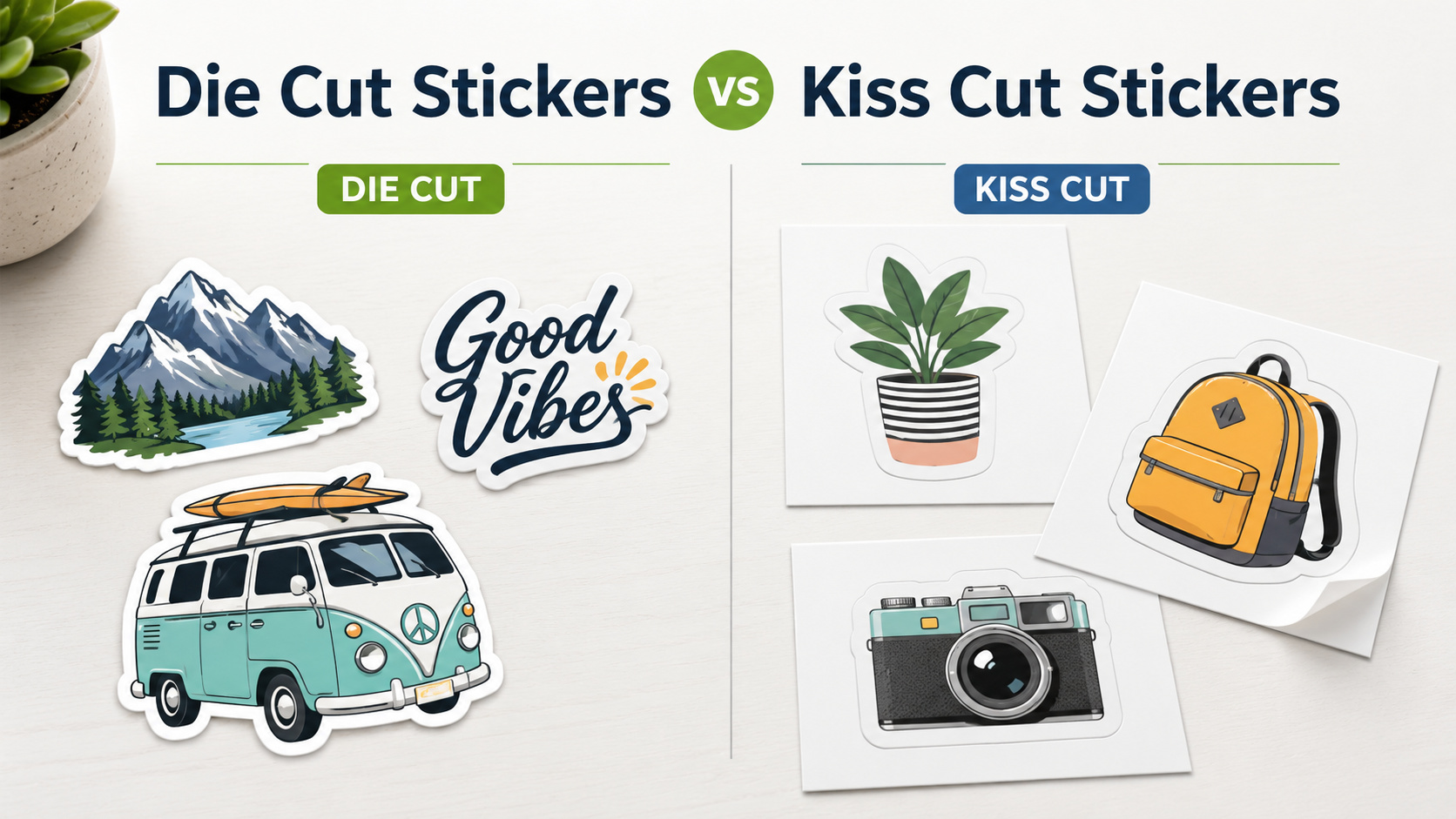
Die cut stickers are cut through both the sticker material and the backing paper, so the entire piece follows the shape of the design. Kiss cut stickers are cut through the sticker material only, leaving extra backing paper around the peelable design.
Choose die cut stickers for individual giveaways, logo stickers, merchandise, and a clean custom shape. Choose kiss cut stickers when easy peeling, added backing artwork, delicate designs, or multiple stickers on one sheet matter more.
Once applied, neither cut style is automatically more durable. Material, adhesive, ink, laminate, surface preparation, and exposure have a much larger effect on sticker life.
What Is the Difference Between Die Cut and Kiss Cut Stickers?
The difference between die cut stickers and kiss cut stickers comes down to how deeply the cutting blade travels.
A die cut passes through the printed sticker material and its paper backing. The finished piece is trimmed to the outline of the design.
A kiss cut passes through the sticker material but stops before cutting through the backing paper. The sticker peels away in its custom shape, while the larger backing remains intact.
That may sound like a small production detail, but it affects how the sticker looks before application, how easy it is to peel, how it can be packaged, and how much room you have for extra branding.
The sticker that ends up on the customer’s water bottle may look nearly identical either way. The main difference is what the customer holds before peeling it.
What Are Die Cut Stickers?
Die cut stickers are individual stickers cut to the outer shape of the artwork. Both the vinyl and release liner follow the same general outline.
A round logo becomes a round sticker. A lightning bolt becomes a lightning-bolt-shaped piece. A character design can follow the character’s silhouette instead of sitting inside a plain square or rectangle.
Modern die cutting is often completed with digitally controlled equipment rather than a separate metal cutting die for every design. The term remains common because it describes the finished cut: the blade travels completely through the sticker material and backing.
This creates a polished presentation even before the sticker is applied. There is no large rectangle of backing paper surrounding the design. What you see in your hand is close to what the sticker will look like on its final surface.
Die cut stickers are commonly used for:
- Business logo giveaways
- Artist merchandise
- Water bottle stickers
- Laptop stickers
- Event handouts
- Product package inserts
- Promotional sticker packs
- Branded helmets, cases and equipment
Custom die cut stickers are especially useful when the outer silhouette is an important part of the artwork. They allow a mascot, logo, product, animal or illustrated object to retain its recognizable shape.
What Are Kiss Cut Stickers?
Kiss cut stickers are cut to a custom shape without cutting through the entire backing sheet.
The blade applies enough pressure to separate the face material, but the release liner stays in one piece. That is where the name comes from: the blade lightly “kisses” the backing rather than slicing through it.
The finished sticker may sit inside a square, rectangle, circle or another larger outer shape. Once peeled, the applied sticker can follow the same custom outline as a die cut sticker.
The extra backing area can make the sticker easier to handle and peel. It can also protect small points, narrow extensions and delicate cut details before application. Kiss cut stickers are often used when the design would be awkward to peel directly from an equally detailed backing.
Common uses include:
- Sticker sheets
- Product labels
- Planner stickers
- Small decals
- Children’s sticker activities
- Promotional cards
- Packaging seals
- Instructional stickers
- Artist sticker collections
Kiss cutting also allows several separate designs to share one backing sheet. Each design receives its own cutline, but the sheet remains together until the individual stickers are peeled away.
Die Cut Stickers vs Kiss Cut Stickers at a Glance
| Feature | Die Cut Stickers | Kiss Cut Stickers |
|---|---|---|
| Sticker layer | Cut to the custom shape | Cut to the custom shape |
| Backing paper | Cut to the outer shape | Remains around the sticker |
| Presentation | Clean individual piece | Sticker displayed on larger backing |
| Peeling | Can be harder with small or detailed shapes | Usually easier to peel |
| Extra printed space | Limited | Can include added artwork or information |
| Multiple designs | Usually supplied as separate pieces | Can be placed together on a sheet |
| Best for | Giveaways, logos and merchandise | Sheets, labels and delicate designs |
| Applied appearance | Custom shape | Can look the same after peeling |
| Durability | Depends on materials and production | Depends on materials and production |
Which Type Looks Better?
Die cut stickers generally have a cleaner appearance as individual pieces.
Because the backing follows the sticker’s shape, the design is immediately recognizable. This can make die cut stickers feel more finished when they are sold as merchandise, displayed at a checkout counter, included with an order or handed out at an event.
The shape itself becomes part of the presentation.
Kiss cut stickers can look better when the backing is intentionally designed. The extra area can include:
- A business name
- Website information
- Social media details
- Application instructions
- A promotional message
- A matching background pattern
- A second printed illustration
- A short description of the artist
In that situation, the backing is not wasted space. It becomes a small presentation card that supports the sticker.
The better-looking format depends on the goal. Die cut stickers make the individual sticker the focus. Kiss cut stickers give you more room to frame and explain it.
Which Type Is Easier to Peel?
Kiss cut stickers are usually easier to peel.
The larger backing gives the customer room to bend the liner and get a finger beneath the sticker edge. This is helpful for small stickers, narrow shapes and designs with intricate outlines.
A tiny die cut sticker can be difficult to separate from its backing because the sticker and liner have nearly identical edges. Customers may need to pick at the perimeter, which can bend a corner or leave fingernail marks.
That does not mean die cut stickers are always frustrating to use. A medium-sized design with a clean outline is generally easy to peel. The difference becomes more noticeable as the sticker gets smaller or more detailed.
Kiss cuts are worth considering when the design contains:
- Thin arms or legs
- Narrow lettering
- Small points
- Detailed leaves or petals
- Antennas
- Irregular borders
- Closely spaced curves
- Several separate elements
The backing helps support those details until the customer is ready to apply the sticker.
Are Die Cut or Kiss Cut Stickers More Durable?
Neither cutting style is inherently more durable after application.
If a die cut sticker and a kiss cut sticker use the same vinyl, adhesive, ink and protective laminate, their long-term performance should be similar once they are peeled and placed on a surface.
Durability depends more on:
- Sticker material
- Adhesive type
- Protective laminate
- Print quality
- Surface preparation
- Application temperature
- Sun exposure
- Moisture
- Abrasion
- Cleaning methods
A laminated vinyl kiss cut sticker can be more durable than an unlaminated paper die cut sticker. The cut format alone does not tell you how long a sticker will last.
The extra backing on a kiss cut sticker can provide some protection before application. It may help prevent delicate edges from bending during shipping, storage or handling. But that backing is discarded when the sticker is applied, so it does not improve outdoor durability afterward.
Which Is Better for Business Giveaways?
Die cut stickers are usually the stronger choice for simple business giveaways.
They are easy to place in a bowl at a counter, hand out at an event, include in an online order or arrange on a display. The custom shape makes the logo or design recognizable before the sticker is peeled.
A well-designed die cut sticker can feel like a small piece of merchandise rather than a disposable advertising insert. That matters because people are more likely to keep and use a sticker they actually like.
Kiss cut stickers make more sense when the giveaway needs context. The extra backing can explain a promotion, display a URL or show how the sticker connects to the brand.
For example, a bakery could place a cupcake-shaped sticker on a printed backing that includes its location and ordering information. An artist could include a short biography or social handle around the artwork.
Use die cut stickers when the design can stand on its own. Use kiss cut stickers when the supporting information is part of the experience.
Which Is Better for Packaging?
The answer depends on how the stickers will be applied.
Individual die cut stickers work well when employees apply them by hand to bags, boxes, tissue paper or mailers. The custom silhouette can make plain packaging feel more branded.
Kiss cut sticker sheets are useful when a packing station needs several label types in one place. A single sheet might include:
- Logo seals
- Thank-you stickers
- Fragile labels
- Flavor labels
- Size markers
- Care instruction stickers
- Promotional stickers
The employee can peel the needed design without sorting through several piles of individual stickers.
For high-volume product labeling, roll labels may be more efficient than either individual die cut or sheet-based kiss cut stickers. Roll labels are designed for faster dispensing and can often be used with label applicators. Die cut and kiss cut stickers are usually better for promotional use, smaller batches or manual application.
Which Is Better for Artists?
Both formats work well for artists, but they support different products.
Die cut stickers are a good fit for selling individual illustrations. Each design becomes its own finished item and can be packaged, priced or displayed separately.
Kiss cut sticker sheets are useful for collections. An artist can group several related characters, expressions, icons or decorative elements on one backing sheet. This works well for planners, scrapbooks, journals and themed sticker sets.
A few practical examples:
- Sell a large character illustration as a die cut sticker.
- Sell several facial expressions as a kiss cut sheet.
- Use die cuts for premium individual designs.
- Use kiss cuts for smaller supporting icons.
- Combine both formats in a coordinated product collection.
There is no need to choose one format for every piece of artwork.
How Cutlines Affect the Finished Sticker
A cutline is the path that tells the cutting equipment where to cut. It is generally created as a vector outline and does not appear as a printed line on the final sticker.
A die cut sticker normally needs one primary outer cutline. The machine follows that path through the sticker and backing.
A kiss cut sticker may require two cut paths:
- An inner kiss cut around the peelable sticker
- An outer cut that determines the shape of the backing card or sheet
Sticker sheets require a separate kiss cut around every peelable design, along with an outer cut around the complete sheet.
Most customers do not need to create production-ready cutlines themselves. A sticker printer can usually generate a cutline around submitted artwork and show its placement in a proof.
Still, designers should think about the cut during the artwork stage. Tiny gaps, extremely thin extensions and sharp points may not cut or peel as cleanly as a simpler outline.
Design Tips for Die Cut Stickers
Die cut designs work best when the silhouette remains clear.
A border around the artwork can help connect separate details and create a stronger outer shape. Without a border, small pieces may become fragile or require a different product such as a transfer sticker.
Keep these points in mind:
- Avoid very thin protruding sections.
- Use rounded corners where possible.
- Make small text large enough to print clearly.
- Leave safe space between important details and the cutline.
- Check that the design still makes sense from a distance.
- Consider how the sticker will look before and after application.
- Review the proof at the intended physical size.
A complex cutline does not automatically make a sticker better. Sometimes a slightly simplified outline gives the artwork a cleaner appearance and makes the sticker easier to handle.
Design Tips for Kiss Cut Stickers
The main advantage of kiss cutting is the extra backing space, so decide whether that space should remain blank or support the design.
You can use the backing to:
- Extend the background artwork
- Add instructions
- Include contact information
- Display a logo
- Create a decorative frame
- Number a limited edition
- Explain a promotion
- Group several stickers by theme
Make sure customers can tell which portion peels away. A visible contrast between the sticker and backing artwork can help.
For sticker sheets, leave enough room between individual designs for clean cutting and easy peeling. Overcrowding the page may give you more stickers in theory, but it can make the finished sheet harder to use.
Are Kiss Cut Stickers the Same as Sticker Sheets?
Sticker sheets use kiss cuts, but not every kiss cut sticker is a full sticker sheet.
A single kiss cut sticker may contain one peelable design on a larger square or rectangular backing.
A sticker sheet normally includes several separate peelable designs on one shared backing. Each sticker has its own cutline, while the full sheet remains intact.
This distinction matters when ordering. Asking for a kiss cut sticker may produce one design with extra backing. Asking for a sticker sheet tells the printer that you want multiple peelable elements grouped on a page.
Are Die Cut Stickers More Expensive?
There is no universal price winner.
Pricing depends on the printer, sticker size, quantity, material, finish, number of designs and production format. A single custom kiss cut card may cost more than a basic die cut sticker because it uses more material and may include extra printing. A sticker sheet may provide good value when several small designs need to be grouped together.
Compare the full product rather than assuming one cutting method is always cheaper.
Also consider how the stickers will be used. Paying slightly more for easy-peel kiss cuts may be worthwhile when employees apply hundreds of labels by hand. Die cuts may offer better promotional value when the finished shape encourages customers to keep the sticker.
Die Cut Stickers vs Kiss Cut Stickers: Which Should You Choose?
Choose die cut stickers when:
- You want a clean individual sticker.
- The design should be recognizable before peeling.
- You plan to hand out stickers at events.
- You are selling individual artwork.
- You want the outer shape to be part of the presentation.
- You do not need extra information on the backing.
Choose kiss cut stickers when:
- Easy peeling is important.
- The design has delicate edges.
- You want to print on the surrounding backing.
- You need several stickers on one sheet.
- The stickers will be used for planners or crafts.
- You want a backing card that protects the design during handling.
For many businesses, the answer is not one or the other. Die cut stickers may be better for customer giveaways, while kiss cut sheets may be more convenient behind the packing table.
The Bottom Line
The difference between die cut stickers and kiss cut stickers is not the shape of the applied sticker. It is what happens to the backing paper.
Die cut stickers are trimmed through every layer, creating a clean individual piece shaped around the design. Kiss cut stickers leave the backing intact, making the sticker easier to peel and creating room for extra artwork, information or multiple designs.
Choose die cut stickers when presentation and individual distribution matter most. Choose kiss cut stickers when handling, added backing space or sticker-sheet organization is more useful.
And remember that cut style does not determine durability. A well-made sticker still needs the right material, adhesive, ink and laminate for its intended use.