
TLDR
For most riders, the best way to turn a dirt bike around on a narrow trail is a controlled multi-point turn. Stop at the widest stable section, look for holes and exposed edges, angle the front wheel across the trail, stop before running out of ground, then roll or walk the bike backward with the bars turned the opposite way. Repeat with short movements until the bike faces out. If the trail is steep, slick, or exposed, shut off the engine and reposition from the uphill side rather than gambling on a flashy pivot turn.
Start by finding usable ground
Do not begin the turn merely because you have decided to go back. Move to the nearest wider, flatter patch if you can reach it safely. A small bench, trail junction, firm inside corner, or opening between trees can turn a desperate maneuver into an ordinary three-point turn.
Stop and inspect both edges. Look for loose soil, buried rocks, roots, deep ruts, soft shoulders, snow-covered holes, and vegetation hiding a drop. Check above you as well: handlebars and hand guards can snag branches while your attention is fixed on the tires.
Route rules still matter when choosing where to maneuver. The Bureau of Land Management OHV guidance directs riders to follow posted route designations and restrictions, which can limit travel to existing roads and trails. Keep the tires on the established riding surface rather than cutting a fresh turnaround into vegetation.
Use the controlled multi-point turn
This is the dependable technique because every movement is small enough to stop and correct. There is no universal amount of trail width that guarantees success. Steering lock, wheelbase, handlebar width, terrain, luggage, and rider balance all change the space required. Yamaha has identified handlebar turning angle as a model-specific maneuverability feature, reinforcing that different motorcycles will not carve the same tight arc.
- Stop with both feet available and select first gear. Keep one or two fingers ready on the clutch and front brake.
- Turn the bars toward the direction you want the front of the bike to travel. Ease forward at walking speed, using clutch control rather than a burst of throttle.
- Stop while both tires remain on firm ground. Do not let the front tire hang over the outside edge just to gain another few inches.
- If the bike can roll backward safely, turn the bars the other way and back up a short distance. Use the front brake to arrest the movement, not to drag the tire continuously down the slope.
- Repeat the short forward-and-back movements until the bike points along the return route. Straighten the bars, confirm your footing, and restart smoothly.
Keep the motorcycle as upright as the terrain allows. A slight lean toward the inside of the trail can help balance the bike, but a deep lean consumes space and makes a stall harder to catch. Turn your head and look at the next tire placement rather than staring at the outside edge.
Yamaha training material has used a 3-meter-diameter circle drill to develop awareness of machine width and smooth low-speed control. That is a practice exercise, not a universal dirt-bike turning specification, but it offers a useful lesson: learn your bike’s steering lock and balance on level ground before a cliffside trail demands the answer. Yamaha’s safe-riding training material describes the drill.
When to dismount and walk the bike
Dismount when the trail is too steep or slippery to support a feet-down turn, when the outside edge has serious exposure, or when luggage makes the bike top-heavy. Whenever possible, stand on the uphill side so the motorcycle does not fall into you. Keep your body clear of the downhill side and never place a foot where the machine could trap it against a rock or log.
The conservative option is to shut off the engine, select neutral if the bike will roll controllably, and move it in short increments while using the front brake. On a slope, leaving the bike in gear can provide resistance, but you may need to operate the clutch to reposition it. Exact behavior varies with the motorcycle and grade, so test the load before committing.
Walking beside a running bike with clutch and throttle can move it through difficult ground, and riders report using that method during multi-point turns. It also adds the risk of an unexpected surge while you are poorly positioned. Treat it as an experienced-rider technique, not the default procedure.
Choose the technique that matches the terrain
| Method | Best use | Main problem |
|---|---|---|
| Mounted multi-point turn | Firm, moderately level singletrack | Requires reliable low-speed clutch and brake control |
| Engine-off walking turn | Steep, exposed, slick, or awkward ground | Bike can become heavy and difficult to arrest |
| Rear-end lift or pivot | Light bike on stable ground with a confident rider | Strain, poor footing, and an uncontrolled drop |
| Power or wheel-spin turn | Closed practice area with ample runoff | Traction loss, trail damage, and little room for error |
Sidestand pivots, rear-wheel pivots, wheelie turns, and spinning turns all appear in rider discussions. None should be your automatic answer on public singletrack. A stand can sink or fold, lifting can injure the rider or damage the bike, and spinning the rear tire can dig a rut while launching the motorcycle toward the trail edge. Community riders also describe these methods as highly dependent on terrain and experience.
Adjust for slopes, mud, ice, and snow
On a steep sidehill, gravity is the real steering input. Favor a location where the motorcycle can point slightly downhill during part of the maneuver, but only if there is adequate stopping room and no exposure below. Avoid backing toward a drop or trying to hold the full weight of the bike from the downhill side.
Mud, wet roots, ice, and loose rock reduce how much braking and side load the tires can support. Make each movement shorter, keep throttle input quiet, and avoid planting a foot on a polished root. Riders heading into mountain terrain should also prepare the motorcycle and route before the ride; this high-altitude dirt bike setup guide covers the mechanical side of that planning.
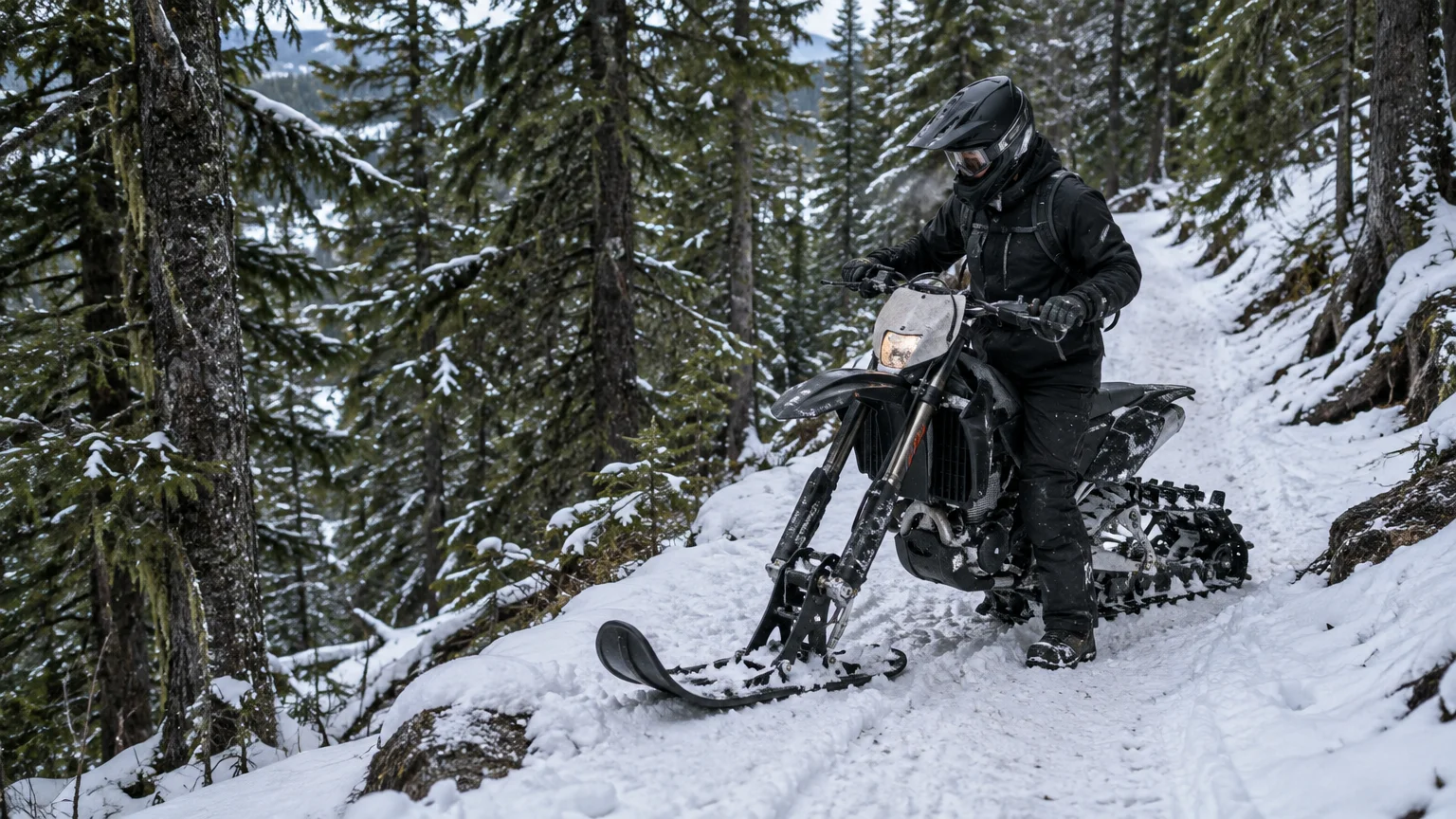
A snow bike requires a different approach because its ski and track do not reposition like two rolling wheels. Polaris advises snow-bike riders to practice turning, leaning, braking, traversing, and throttle control in a safe, flat, open area before entering mountainous terrain. Its Timbersled guidance also recommends turning downhill where possible if the machine is about to become stuck. Polaris snow-bike operating guidance provides the model-specific context.
Before moving a snow bike, verify that packed snow or ice is not blocking steering or brake operation. The 2025 Timbersled Ripper manual specifically calls for manually checking ski movement in both directions and keeping the brake lever clear of snow, ice, and accessory interference. For broader winter hazards, review the safety risks of dirt biking in snow before treating a frozen trail like ordinary summer singletrack.
Prevent the bad turnaround before the ride
Scout the route, know your fuel range, and leave enough energy to reverse course before weather or darkness forces the decision. The BLM recommends carrying water, maps, tools, and fuel, leaving a riding plan, using protective equipment, riding within your ability, and avoiding solo travel. BLM’s OHV trip-planning guidance is a useful baseline.
Then practice the maneuver somewhere boring: flat ground, no traffic, and no exposed edge. Work on full-lock circles, stopping with either foot, backing the bike under control, and completing five- or seven-point turns without rushing. The goal is not to make every turnaround look impressive. It is to make the bike face home without damaging the trail, dropping the machine, or turning a minor navigation mistake into a recovery operation.
References
- Off-Highway Vehicles | Bureau of Land Management
- Fort Sage Off-Highway Vehicle Area – California | Bureau of Land Management
- New Big Single offering a great marriageof ease of use in city riding and high-speed cruising performance New 2004 European market model Yamaha "XT660R" debuts at Milano Show – News releases | Yamaha Motor Co., Ltd.
- GRAM
SAFE RIDING ORGANIZATION CHART
<visual_elem
- How to turn round on tight trails? : r/Dualsport
- Get to Know Your Snow Bike – Polaris Online Publication Portal
- 2025 Timbersled Ripper Owner’s Manual – Polaris Online Publication Portal
- BLM highlights planning, safety for off-highway motor vehicles during OHV Safety Awareness Week | Bureau of Land Management