TLDR
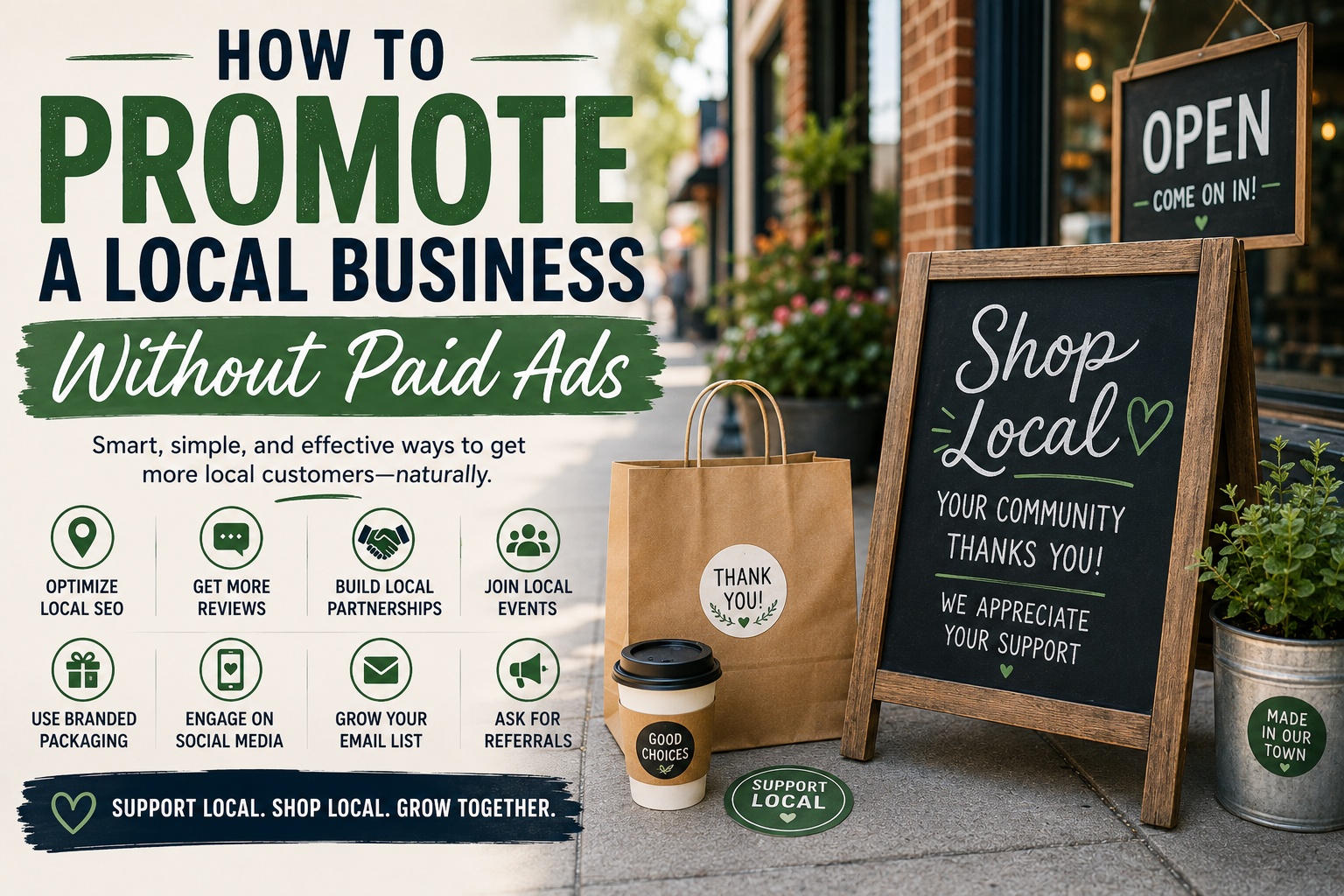
- Start with the free places customers already search: Google Business Profile, your website, maps, review platforms, and social media.
- Make your storefront, packaging, receipts, stickers, and customer interactions do more of the marketing work.
- Ask for reviews, referrals, and local partnerships in a clear, simple way.
- Use events, community groups, email, and local content to stay visible without buying ads.
- The best way to promote a local business without paid ads is to build repeatable habits, not chase random attention.
Paid ads can work, but they are not the only way to get local customers. For many small businesses, the better first move is to tighten the basics: show up where people search, make the in-person experience easier to remember, and give happy customers simple reasons to come back.
That is the practical way to promote a local business without paid ads. You are not trying to be everywhere. You are trying to be visible in the right places, recognizable in your neighborhood, and easy to recommend.
Make Your Google Business Profile Useful
For a local business, your Google Business Profile is often more important than your social media profile. People use it when they are ready to visit, call, get directions, check hours, read reviews, or compare nearby options.
Start with the basics:
- Correct business name
- Current hours
- Phone number
- Website
- Address or service area
- Business category
- Photos of the storefront, products, team, and work
- Service or product descriptions
- Frequently asked questions
- Review responses
Then keep it active. Add posts for events, seasonal updates, new products, service changes, limited-time offers, or helpful reminders. You do not need to post every day. But a profile that looks current gives customers more confidence than one that feels abandoned.
Photos matter too. Add pictures that help people recognize your location, understand what you sell, and feel more comfortable visiting. A good storefront photo, product photo, menu photo, or before-and-after photo can answer questions faster than a paragraph of copy.
Ask for Reviews Without Making It Awkward
Reviews are one of the strongest free marketing tools a local business has. They help customers decide if they trust you, and they can improve how your business appears in local search.
The key is to ask at the right time. Ask after a good experience, not before the customer has had one.
A simple review request can sound like this:
“Thanks again for coming in today. Reviews really help local customers find us. If you had a good experience, we’d really appreciate a quick Google review.”
That is enough. No pressure. No long speech.
You can also add review reminders to:
- Receipts
- Thank-you cards
- Packaging inserts
- Follow-up emails
- Appointment texts
- QR code cards
- Counter signs
Avoid paying for reviews or offering discounts in exchange for positive reviews. Keep the request honest. You want real customer feedback, not something that feels forced.
Turn Packaging Into Local Marketing
Packaging is often overlooked because it feels like an operational detail. But for local businesses, packaging can become one of the most useful low-cost marketing tools.
Think about the things customers take with them:
- Coffee cups
- Takeout bags
- Bakery boxes
- Retail bags
- Product jars
- Candle boxes
- Salon product bags
- Event giveaways
- Shipping mailers
- Thank-you cards
Each one is a chance to make the business easier to remember.
A branded sticker on a plain bag can make a simple order feel more finished. A QR code sticker can point customers to your review page, loyalty program, menu, or reorder page. A small sticker freebie can end up on a laptop, water bottle, notebook, toolbox, or car window.
For local promotions, custom stickers for small businesses work well because they are easy to hand out, include in orders, or use on packaging without changing your full packaging system.
This is especially useful for businesses that already have walk-in traffic. You do not need to “market” to a customer who is already holding your product. You just need to make the next step clear.
Build a Simple Referral Habit
Referrals are not automatic. Even happy customers forget to mention a business unless there is a reason or reminder.
Create a simple referral system that is easy to explain.
For example:
- Bring a friend and both get a small perk.
- Refer a neighbor and receive a small thank-you.
- Share this card with someone local.
- Tag us when you post your order.
- Give this sticker to a friend who would like us.
The reward does not need to be huge. It just needs to feel clear and fair.
A gym could offer a free class pass for a friend. A bakery could include a “share with a neighbor” card. A salon could offer a small product sample for referrals. A coffee shop could use a stamp card. A boutique could give regular customers a small referral card to pass along.
The best referral programs are simple enough that employees can explain them in one sentence.
Partner With Nearby Businesses
Local businesses do not need to compete for every bit of attention. Many can grow by sharing audiences with nearby businesses that serve similar customers.
Good partnership ideas include:
| Business Type | Partnership Idea |
|---|---|
| Coffee shop | Partner with a bookstore, florist, or bakery |
| Gym | Partner with a nutrition coach or physical therapist |
| Boutique | Partner with a salon, photographer, or gift shop |
| Restaurant | Partner with a local event venue |
| Pet groomer | Partner with a pet store or vet clinic |
| Candle brand | Partner with a spa, boutique, or wedding planner |
Keep the partnership specific. “Let’s collaborate sometime” usually goes nowhere. Try something clearer.
Example:
“We’re putting together a small local gift bundle for next month and thought your products would fit well. Would you be open to including one item or a small offer card?”
Partnerships work best when both businesses benefit and the offer makes sense to the customer.
Show Up at Local Events
Local events can promote a business without paid ads because they put you in front of people who live, work, and shop nearby.
You do not need a giant booth. A small, clear setup is better than a crowded table.
Bring:
- A simple sign
- Business cards or QR code cards
- Product samples
- A small giveaway
- A signup sheet or email QR code
- Stickers or branded handouts
- Clear pricing
- A short explanation of what you do
The follow-up matters more than most people think. If someone visits your table, give them a reason to connect again. Ask them to join your email list, follow your social profile, scan a menu, book a consultation, or visit your location.
For event handouts, packaging seals, or local promo materials, start here: https://customstickers.com/
A local event should not end when you pack up the table. Post photos, tag organizers, thank customers, and invite people to the next thing.
Use Social Media Like a Local Window Display
Social media does not need to be complicated. For a local business, the goal is usually to remind nearby customers that you exist and give them a reason to visit.
Post things people can act on:
- New arrivals
- Behind-the-scenes work
- Staff picks
- Restocks
- Seasonal products
- Limited menu items
- Customer photos
- Local event updates
- Before-and-after examples
- Common questions
- Short tips related to your product or service
Use location tags when they make sense. Mention your city, neighborhood, market, or nearby landmarks naturally. Tag partner businesses and local event organizers.
You do not need every post to be polished. A useful post that clearly shows what is available today can outperform a beautiful post that tells customers nothing.
A simple weekly rhythm can work:
| Day | Post Idea |
|---|---|
| Monday | What is new this week |
| Wednesday | Behind-the-scenes or staff pick |
| Friday | Weekend reminder or local event |
| Sunday | Customer photo, review, or FAQ |
Consistency matters more than volume. It is better to post three useful updates a week than disappear for a month and then post ten times in one day.
Make Your Storefront Work Harder
If you have a physical location, your storefront is free media. Use it.
Check the basics:
- Can people quickly tell what you sell?
- Are your hours visible?
- Is there a clear sign?
- Are seasonal updates easy to see?
- Can pedestrians understand your offer in three seconds?
- Is there a QR code for menus, booking, ordering, or reviews?
- Does the window display change often enough to feel active?
Even a small A-frame sign can help if the message is clear. Avoid vague lines like “Come see us.” Use something specific.
Better examples:
- Fresh cinnamon rolls until noon
- Walk-in appointments open today
- New spring candles are in
- Free tasting this Saturday
- Local art prints under $25
- Scan to join our rewards list
The sign should answer the customer’s quiet question: “Why should I stop right now?”
Build an Email or Text List Early
Social media platforms change. Search results change. Local foot traffic changes. Your customer list is more stable.
Start collecting emails or phone numbers with a clear reason:
- Get first notice of new products
- Receive a birthday offer
- Join the local rewards list
- Get weekly specials
- Hear about events
- Receive restock alerts
- Get seasonal menus or appointment openings
Do not overdo it. One helpful message a week or a few messages a month may be enough for many local businesses.
Make the signup easy. Use a QR code at checkout, on packaging, at events, or on printed inserts. Train staff to mention it in a natural way.
Example:
“We send one email a week with specials and local events. There’s a QR code by the register if you want to join.”
That feels much better than pushing someone into a list without context.
Create Local Content People Search For
Local content can help people find you without ads. This does not mean writing long blog posts every week. It means answering the questions local customers already have.
A bakery might write:
- Best Desserts for Office Parties in [City]
- How to Order Custom Cookies for a Local Event
- What to Bring to a Neighborhood Potluck
A mechanic might write:
- How Often Should You Rotate Tires in [City]?
- What to Check Before a Summer Road Trip
- Why Local Winter Roads Are Hard on Brakes
A boutique might write:
- What to Wear to a Spring Wedding in [City]
- Gift Ideas From Local Shops in [Neighborhood]
- How to Build a Simple Capsule Wardrobe
Local pages, guides, FAQs, and service pages can all work. The goal is to be useful and specific. Generic content has to compete with everyone. Local content has a better chance because it answers a narrower question.
Put QR Codes Where They Actually Help
QR codes are not magic. They work when the next step is obvious.
Good QR code uses include:
- Review page
- Menu
- Booking page
- Loyalty signup
- Event RSVP
- Reorder page
- Product care instructions
- Local guide
- Email signup
- Social profile
Bad QR code use is when the customer scans and lands on a vague homepage with no clear next action.
Label the QR code. Tell people what will happen.
Use:
- Scan to leave a review
- Scan to reorder
- Scan for this week’s menu
- Scan to book
- Scan for care instructions
- Scan to join rewards
For repeated QR code labels, custom sticker rolls can work well on bags, boxes, jars, event cards, and counter materials.
Get Involved in the Community Without Making It a Sales Pitch
Community involvement works best when it is genuine. People can usually tell when a business is only showing up to extract attention.
Look for real ways to help:
- Donate a small prize to a school fundraiser
- Sponsor a local youth team
- Host a small workshop
- Offer your space for a community meetup
- Participate in a sidewalk sale
- Support a local charity event
- Share nearby businesses on social media
- Create a local gift basket with other shops
Not every community effort needs to produce immediate sales. Some build trust over time. That is still marketing, just slower and more grounded.
A local business becomes familiar when people see it repeatedly in useful places.
Track What Brings People In
Free marketing still costs time. Track what works.
Ask customers simple questions:
- How did you hear about us?
- Did someone refer you?
- Did you find us on Google?
- Did you see us at the market?
- Did you scan the QR code?
- Are you on our email list?
Keep a simple note in your point-of-sale system, spreadsheet, or notebook. After a month, patterns will start to show.
You may find that reviews bring in more customers than Instagram. Or that events bring in email signups but not immediate purchases. Or that a window sign sells more than a week of social posting.
That information helps you spend time better.
A Simple 30-Day No-Ad Promotion Plan
Use this plan if you need a starting point.
| Week | Focus | Actions |
|---|---|---|
| Week 1 | Local search | Update Google Business Profile, add photos, refresh hours, answer FAQs |
| Week 2 | Customer proof | Ask recent happy customers for reviews, respond to old reviews |
| Week 3 | In-person visibility | Add QR codes, stickers, signage, packaging inserts, and referral reminders |
| Week 4 | Community reach | Contact 3 local partners, attend or post about one local event, send one email |
This is not flashy. That is the point. It builds the habits that make a local business easier to find and easier to remember.
Conclusion
You can promote a local business without paid ads by making the business easier to find, easier to recognize, and easier to recommend.
Start with your Google Business Profile. Ask for reviews at the right time. Use packaging, stickers, QR codes, storefront signs, local partnerships, community events, social content, and email to stay visible. Keep the system simple enough to repeat.
Paid ads can always come later. But the free work should come first, because it improves everything else you do.