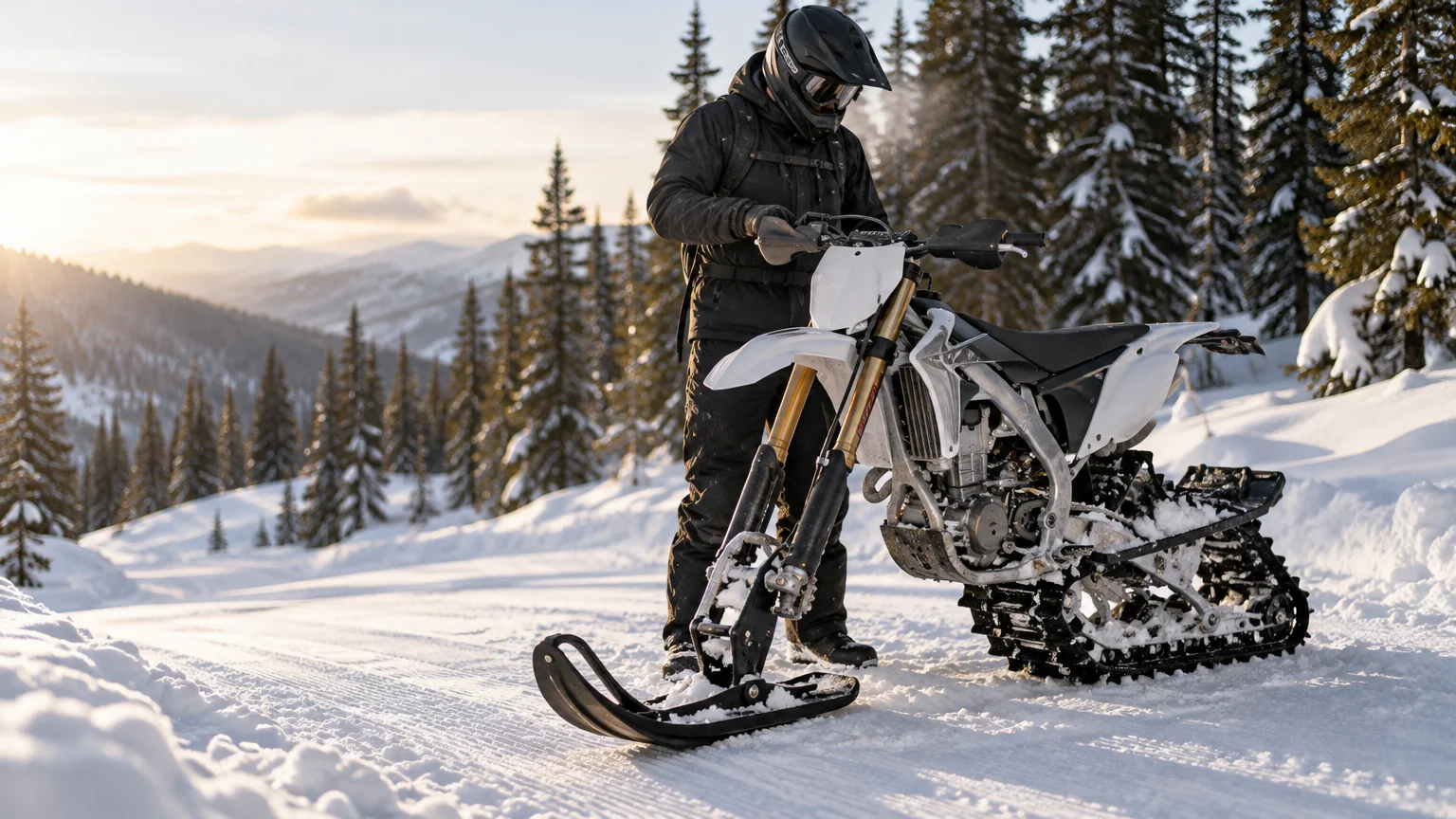
TLDR: The best dirt bike for snow bike conversion is usually a healthy modern fuel-injected 450 motocross bike with confirmed fitment for the exact track system. That is the strongest default for an aggressive, dedicated build—not a universal winner. Choose the conversion kit first, verify the motorcycle’s exact year, make, and model, and then judge engine condition, clutch health, cooling, suspension, parts support, terrain, and summer use.
The hunt for the best dirt bike for snow bike conversion should not begin with brand loyalty or a tempting used-bike price. It begins with compatibility. A powerful motorcycle is useless as a donor if the selected kit lacks the correct spindle, strut rod, spacers, installation hardware, sprocket recommendation, or instructions for that application.
The direct answer: start with a supported EFI 450
For deep snow, mountain riding, and riders who expect the track to work hard, a current-generation fuel-injected 450cc motocross platform is the logical default category. These bikes combine substantial power with relatively low motorcycle weight and performance-focused suspension. Current examples illustrate the formula: Honda lists its 2026 CRF450R as a liquid-cooled, fuel-injected 450cc four-stroke with a five-speed transmission and 249-pound curb weight, while KTM lists the 2026 450 SX-F Factory Edition with a 449.9cc EFI engine, five-speed transmission, 300 mm of suspension travel at both ends, and a weight of 106.4 kg without fuel.
Those specifications do not prove that either model is universally best. They show why modern 450 motocross bikes form the performance-oriented baseline: strong engines, compact chassis, long-travel suspension, and widespread attention from conversion-kit manufacturers. The actual winner is the correctly supported bike in the best mechanical condition.
Timbersled states that its systems use application-specific fitment rather than universal compatibility. Its documentation identifies motorcycle-specific requirements such as spindles, strut rods, subframe spacers, and recommended countershaft sprockets. Check the current Timbersled fitment tables or the corresponding documentation from your kit manufacturer before paying for a donor.
Choose the kit before choosing the bike
This order of operations prevents an expensive garage ornament. Decide which snow system fits your terrain and riding goals, then build a list of supported motorcycles. Only after that should you compare used-bike condition, local parts availability, price, and summer usefulness.
- Select the snow-bike system and configuration appropriate for your intended terrain.
- Find the manufacturer’s current fitment information, not an old forum post or an undated marketplace listing.
- Verify the exact motorcycle year, make, model, and variant. Do not assume adjacent model years share hardware.
- Record every required spindle, strut rod, spacer, mounting component, brake part, and recommended countershaft sprocket.
- Confirm that the required installation kit and replacement wear parts are actually obtainable.
- Inspect candidate motorcycles only after they pass the compatibility check.
If this is your first build, review the broader planning issues in what to know before converting a dirt bike into a snow bike. Fitment is the gatekeeper, but storage, transport, seasonal installation work, maintenance, riding access, and safety can decide whether the finished machine is practical.
Which donor category fits your riding?
Engine displacement alone cannot answer the purchase question. Snow depth, elevation, trail speed, rider weight, summer use, and willingness to maintain a performance motorcycle all affect the decision. The categories below are a decision framework, not a ranking; every candidate still requires exact kit support.
| Donor category | Where it makes sense | Main attraction | What to verify |
|---|---|---|---|
| 450 four-stroke motocross | Deep snow, mountain terrain, aggressive or dedicated builds | Performance-oriented engine and chassis package | Exact kit fitment, clutch and engine condition, service history, installation hardware |
| 250 four-stroke | Mellower terrain or riders prioritizing a less intimidating donor | Potentially manageable power delivery and useful summer role | Whether available output suits the terrain and whether the kit maker supports the exact bike |
| 250/300 two-stroke | Riders who specifically prefer two-stroke character and maintenance | Distinct engine feel and potentially appealing off-road crossover use | Current kit support, gearing instructions, fuel range, cold-weather setup, and model-specific installation details |
| 450/500-class off-road or enduro | Trail-oriented riders and owners wanting broader summer utility | Off-road equipment and multipurpose potential | Weight, transmission behavior, kit compatibility, clearances, and availability of all mounting parts |
| Dual-sport platform | A rider with a very specific multipurpose plan | Road equipment and year-round versatility where legally useful | Conversion support, added weight, registration implications, and whether the platform suits the intended snow |
References
- 2026 CRF450R Motocross Bike Tech Specs| Honda Powersports
- Technical Specifications | 2026 KTM 450 SX-F FACTORY EDITION | KTM United States
- Fitment Tables | Timbersled Snow Bike Systems
- Timbersled ARO FAQ | Timbersled Snow Bike Systems Canada
- How to Install ARO & RIOT Snow Bike Systems on a Dirt Bike | Timbersled