
TLDR
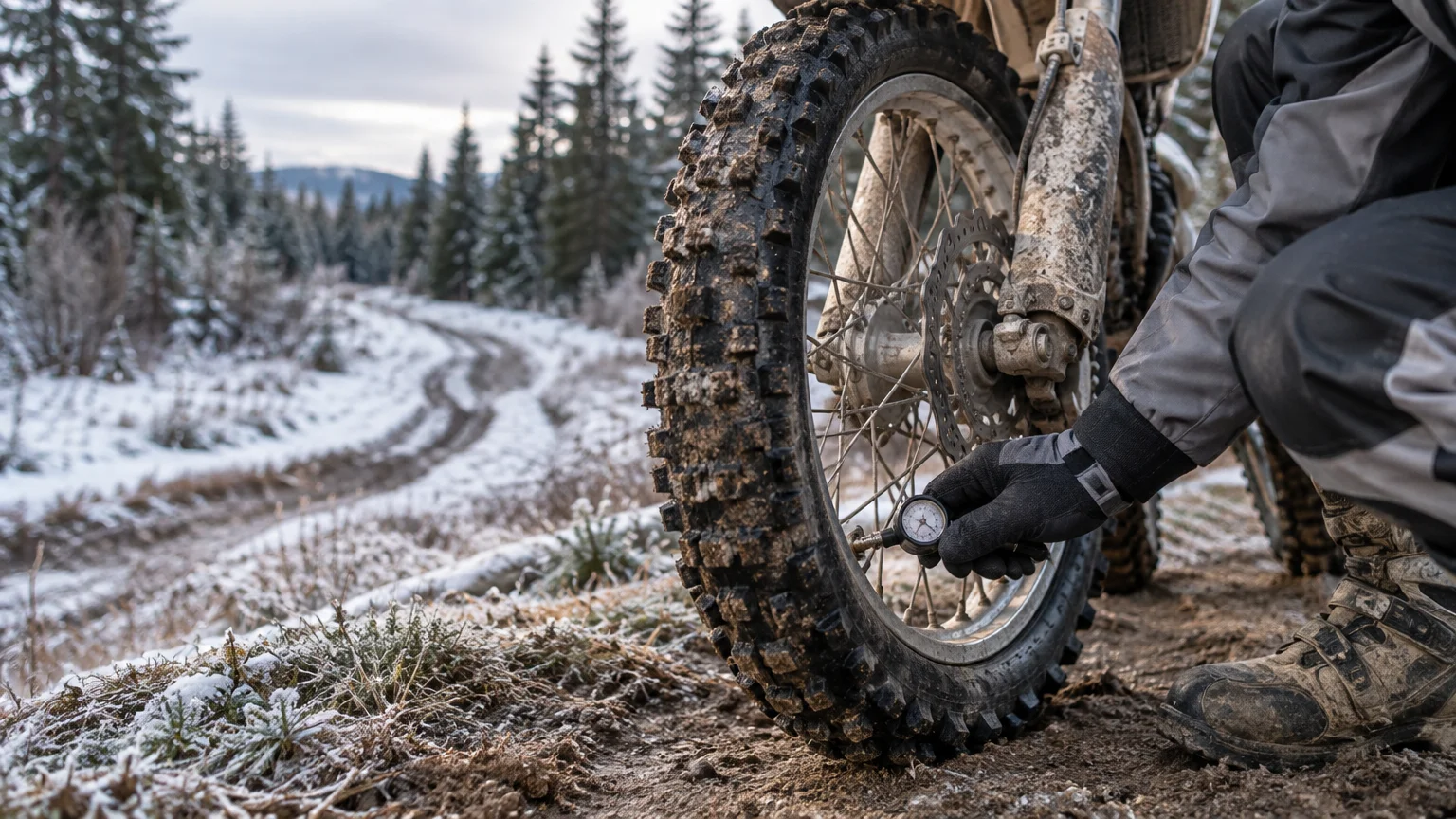
There is no universal dirt bike tire pressure for every bike and trail. Start with the motorcycle manufacturer’s cold-pressure specification and the fitted tire maker’s off-road guidance. From there, soft dirt may justify a modest reduction for grip, while rocks, ledges and higher speeds usually require more tire support. Conventional tubes are less tolerant of very low pressure because pinch flats, tire movement and rim damage become more likely. Check pressure cold, use the same accurate gauge and change one variable at a time.
Start with the specification, not a magic number
Terrain matters, but it does not erase the specifications for the bike and tire. Honda’s CRF450X manual, for example, specifies 15 psi front and rear when cold and advises making condition-specific changes a little at a time. That is a model-specific starting point, not permission to set every dirt bike to 15 psi. Honda’s CRF450X owner’s manual illustrates why the manual belongs in the setup process.
The tire itself can change the answer dramatically. Michelin lists 13.1 psi front and rear for the StarCross 6, 14.5 psi for the Enduro Medium, 11.6 psi for the Enduro Xtrem rear and substantially higher figures of 17.4 psi front and 21.8 psi rear for the Desert Race. These are tire-family recommendations, not a universal terrain chart. Use the documentation for the exact tire installed on the bike. Michelin’s off-road tire-pressure guidance provides the model-specific figures and minimums.
How terrain changes the pressure decision
| Terrain or use | Pressure direction | What you are balancing |
|---|---|---|
| Loam and loose dirt | A modest reduction may help | More contact area and grip versus reduced impact protection |
| Mud and soft ground | Consider slightly lower pressure | Drive and conformity versus tire movement and rim exposure |
| Sand | Often lower than a hard-terrain setup | Flotation and traction versus heat, speed and impact support |
| Roots and mixed trail | Stay near the approved baseline, then tune | Compliance versus unpredictable square-edge hits |
| Rocks, ledges and hardpack | Usually maintain or add support | Rim protection, stability and resistance to pinch flats |
| Fast sections or road transfers | Use the approved setting for that use | Stability, heat management and tire durability |
In soft soil, reducing pressure modestly can enlarge the contact area and help the tire conform to the ground. Go too far and the casing may fold, the tube may pinch against the rim, or the tire may move on the wheel. More grip is useful only if the assembly survives the next embedded rock.
Rocky terrain reverses the priority. Square edges and ledges can drive the tire carcass into the rim, so a pressure that feels excellent in slow loam may be a bad choice in a fast rock garden. Dirt Rider has reported 12–14 psi as an average bike-preparation range and suggests adding a few PSI for severe rocks, but that is reported setup practice rather than a specification for every bike. Dirt Rider’s setup discussion is useful context, while the bike and tire documentation should still control the baseline.
For a mixed loop, set pressure for the most damaging part of the ride, not merely the first soft section near the truck. If the route combines loam, roots, high-speed hardpack and sharp rocks, I would accept a little less soft-ground conformity before sacrificing rim and tube protection.
Conventional tubes change how low you can go
A standard tube-equipped wheel has two major low-pressure failure modes. First, a square-edge impact can trap the tube between the tire and rim, producing the familiar paired cuts of a pinch flat. Second, the tire or tube can creep around the rim under acceleration or braking. That movement can pull the valve stem sideways and eventually tear it.
A rim lock helps resist tire rotation when running reduced pressure. Continental specifically advises using tire holders when pressure is reduced on tube-type tires. It is not a free pass to ignore pressure, tube condition or impact risk; it controls one part of the system. Continental’s motorcycle tire-pressure guidance explains the role of tire holders with reduced tube-type pressures.
Inspect the valve stem before every ride. A stem leaning away from its normal alignment can warn that movement is occurring inside the assembly. Also check the rim, tread and sidewalls for cuts, bulges, embedded objects and impact damage. Do not simply straighten a suspicious valve stem and pretend the underlying movement never happened.
Mousse inserts are not ordinary low-pressure tubes
A mousse replaces pneumatic pressure with a foam insert, so its feel is described as an approximate pressure equivalent rather than adjusted with a gauge. Michelin describes Bib Mousse as roughly equivalent to 11.6–14.5 psi, depending on the application. It is marked NHS, is not road legal, has a listed maximum speed of 80 mph, and its service life varies with riding discipline and intensity.
Other specialized insert or high-pressure inner-chamber systems can also permit setups that would be reckless with a conventional tube. Do not copy a rider’s unusually low gauge reading until you know the exact wheel system, tire, insert, terrain and speed behind it. The hardware changes both the failure modes and what the indicated PSI means.
Measure pressure cold and control the variables
Pressure should be checked cold. Michelin defines that as a tire that has not been ridden for at least two hours, or has traveled less than two miles at reduced speed. Do not bleed a warm tire down to its cold target; after cooling, it will be underinflated. The correct reference is the motorcycle placard or manual plus the applicable tire specification—not the maximum-pressure marking molded into the sidewall. Michelin’s cold-pressure procedure covers these measurement basics.
Temperature and altitude can alter the gauge reading, so yesterday’s setting is not automatically today’s setting. Use the same gauge, check before riding and record the result. A small notebook entry—front, rear, temperature, terrain and outcome—is more useful than trying to remember whether the front felt vague three rides ago.
Do not carry trail pressure onto the highway
Low off-road pressure is not intended for sustained asphalt use. Before a meaningful pavement transfer, restore the approved pressure for that use. Michelin warns that off-road pressures can compromise pavement behavior and contribute to damage or wear. A short technical trail and a fast road connector create different heat, load and stability demands.
A practical pressure-setting routine
- Identify the exact tire model, tube or insert system, and whether each wheel has a properly installed rim lock.
- Find the motorcycle’s specified cold pressure and the tire maker’s applicable off-road recommendation.
- Measure both tires cold with the same gauge before unloading or riding.
- Choose a baseline for the hardest impacts and fastest section expected, not only the softest terrain.
- Make small, documented changes rather than large guesses.
- After the first section, check handling and inspect the valve stems, tire position, sidewalls and rims.
- Reinflate as required before sustained pavement riding, then record what worked.
What about a converted snow bike?
A snow-bike conversion replaces the front wheel with a ski and the rear wheel with a track, so dirt-bike tire pressure does not apply to the installed ski-and-track assembly. It still matters before conversion, after returning the bike to wheels, and while storing or transporting the removed wheels. Riders planning the swap should first understand what changes when converting a dirt bike into a snow bike.
The durable answer
Treat tire pressure as a controlled setup decision, not trailhead folklore. Begin with approved cold specifications, account for the tire and wheel system, then tune cautiously for terrain. Softer ground may reward a modest reduction; rocks, speed, tubes and pavement demand more support. If you cannot identify the tire, tube or insert system behind someone else’s pressure recommendation, do not copy the number.
References
- ……?
- Motorcyle Off-Road Tire Pressure & Michelin Bib Mousse | Michelin USA
- Dirt Bike Advice – Set Up Your Bike from Spokes to Suspension and Setting the Sag – Dirt Rider Magazine | Dirt Rider
- Tire Knowledge Motorcycle Tires – Tire Pressure | Continental motorcyle tires
- Check your Motorcycle Tire Pressure | Michelin Tire Safety
- Install Kits for Snow Bikes | Timbersled